

In this article
- A TikTok Gift is different from a direct donation
- Look at what reaches the mission
- A follower is not yet a donor relationship
- Give supporters a clear path through your website
- Make recurring giving a goal, not an afterthought
- Keep the LIVE. Give it a better purpose.
- The platform can pull the rug out from under you
- Build support that survives a quiet week online
I have been seeing nonprofits rely on TikTok LIVE Gifts to raise money for their cause. I understand the appeal, you can show people what you are doing, answer questions, and receive support while they are watching. For an animal rescue or sanctuary, a live view of the residents can make the mission feel immediate in a way that a written appeal sometimes cannot.
That connection is valuable. The concern is what happens when the live stream becomes the fundraising plan.
A nonprofit needs support that lasts after the camera turns off. It needs a way to receive donations, thank people, explain what their help accomplished, and stay in touch without hoping an app shows them the next video. For many nonprofits, building a dependable base of recurring donors should be a central fundraising goal: the work and the bills continue every month, whether a post goes viral or not.
Social media should help build those relationships. It should not be the only place they exist.
A TikTok Gift is different from a direct donation
When someone sends a virtual Gift during a LIVE, it can feel as though they are handing money directly to the organization on the screen. That is not how TikTok describes the transaction.
Under its current U.S. policy, viewers buy Coins and use them to activate Gifts. TikTok uses engagement, including Gifts, to allocate Diamonds, and popularity is one factor in determining creator rewards. Its policy explicitly distinguishes gifting from transferring money to another user. Diamonds do not automatically guarantee a reward payment. TikTok’s U.S. Virtual Items Policy.
That matters because the amount a supporter spends is not automatically the amount the organization receives.
You will often hear that TikTok takes around half of a Gift’s value. I would be careful about treating that as one fixed, universal fee. The current policy does not promise a simple 50/50 split, and Coin prices differ depending on the purchase method and quantity. The useful question is more concrete: how much did supporters spend, and how much actually reached the organization?
There is also an important distinction here: TikTok has dedicated charitable donation features, including nonprofit links and donation stickers. Those are separate from virtual LIVE Gifts. St. Jude, for example, explains how supporters can use these tools with TikTok-approved nonprofits. Their eligibility, fees, and payment arrangements should be evaluated separately. St. Jude’s guide to fundraising on TikTok.
An organization should know which system it is using and explain it clearly to supporters. Calling everything a donation makes it too easy to overlook where the money goes.
Look at what reaches the mission
Here is a deliberately simplified example, not a statement of TikTok’s current payout rate.
If supporters spend $1,000 through a route that ultimately delivers half that amount, the organization receives $500. If the same $1,000 goes through a donation service with a hypothetical total cost of 3%, it receives $970.
For a sanctuary, that difference could help pay for feed, bedding, fencing, or veterinary care. For another nonprofit, it could support meals, transportation, or supplies.
The comparison is not always that simple. Some people will send a Gift in the app but will not complete a donation somewhere else. A convenient in-app option may bring in money that would otherwise never arrive. A higher-cost channel can still be worthwhile if it brings meaningful additional support.
But that is a reason to measure its value, not a reason to make it the default.
Compare actual payouts, processing costs, staff time, and repeat support. A stream full of animations may look successful while telling you very little about the strength of next month’s fundraising.
A follower is not yet a donor relationship
Someone can follow your account, enjoy your videos, and care about your mission without ever becoming a donor. Someone else can send a Gift once and disappear from your view entirely.
Neither person has done anything wrong. The organization simply needs a next step beyond following.
Can a supporter choose to receive updates by email? Can you thank a donor directly? Can you see their giving history, respect their communication preferences, and explain how their contribution helped? Can someone set up a monthly donation and easily manage or cancel it?
A follower count does not answer those questions. Neither does a list of usernames from last night’s LIVE.
Donor management is the ongoing work of maintaining accurate records, acknowledging support, and building trust. That belongs in a system the organization can access and maintain, with appropriate privacy protections and backups.
For a small nonprofit, the setup can be modest. It does not require an expensive system with enough features to run a small country. It does require reliable records and a deliberate process.
Give supporters a clear path through your website
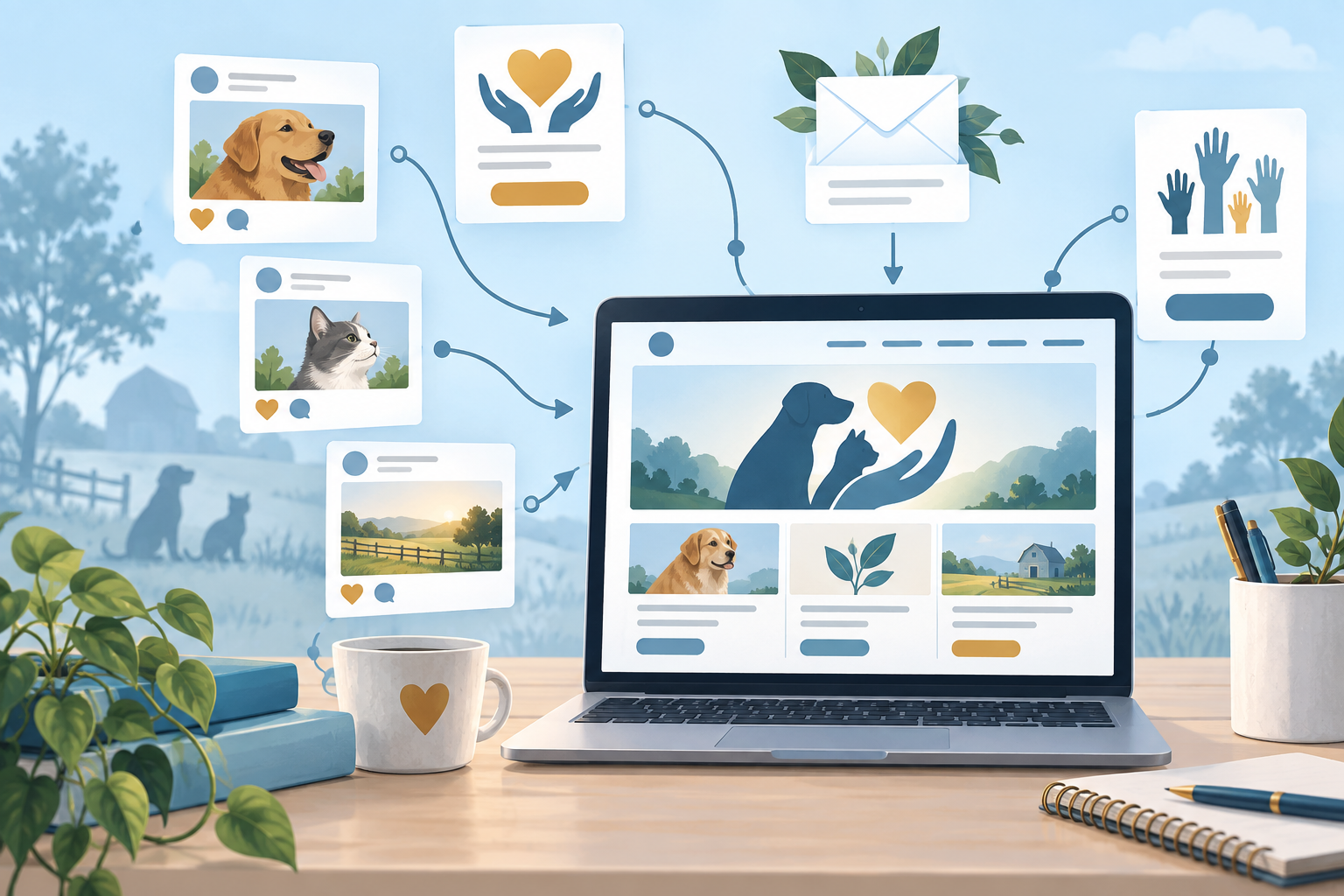
In an earlier article about nonprofit websites, I described the website as the organization’s home on the web. Fundraising is one of the strongest reasons to have that home.
A visitor should be able to understand the mission, see current work, find official contact information, and choose how to help. A clear Donate button should lead to a donation page that works well on a phone and identifies the organization receiving the money.
The website does not need to process payments itself. It can link to or embed a reputable donation service. The organization should compare the service’s current fees, payout arrangements, recurring-giving options, donor-record access, and receipts before choosing it.
One example worth knowing about is Zeffy. For eligible nonprofits, Zeffy charges no platform fees and covers payment processing fees, so the organization receives 100% of the donation. It funds the service through optional contributions to Zeffy at checkout. That contribution is separate from the donation to the nonprofit, and donors can reduce it or set it to zero without reducing what the nonprofit receives. How Zeffy’s zero-fee model works.
That means a $100 donation through Zeffy delivers $100 to the nonprofit. Zero fees deserve attention, but the organization should still check eligibility and make sure the donor experience, payout arrangements, and records meet its needs. I will leave a fuller look at Zeffy, PayPal, and other donation options for a separate article.
The important part is that the nonprofit controls the public address and can change the service behind it when necessary. Supporters should not have to learn a new destination every time the organization changes tools.
The website is the front door. The donation service handles the payment. The donor records and follow-up process support the relationship. Those are connected jobs, but they are not all the same job.
Make recurring giving a goal, not an afterthought
A successful fundraiser can solve an immediate problem. Recurring donations help an organization plan for the work that comes afterward.
Feed, bedding, utilities, insurance, and routine care are ongoing expenses. A sanctuary cannot wait for a popular live stream before deciding whether it can buy next month’s hay. Other nonprofits face the same problem with their own programs and operating costs.
For many organizations, a dependable base of monthly donors should be one of the main goals of fundraising. It gives them a clearer picture of expected income and reduces the need to begin every month with another urgent appeal.
Consider a simple example: 100 supporters giving $10 each month would provide $1,000 a month, or $12,000 over a year, before any applicable fees, assuming every payment succeeds and everyone continues. Those are modest individual contributions, but together they can form a meaningful foundation for ongoing work.
That income is not guaranteed. People cancel, cards expire, and circumstances change. Budget conservatively, monitor failed payments, and keep building a mix of funding sources. One-time donations and emergency campaigns still matter.
But make the monthly option easy to find. Explain what steady support helps sustain, let donors choose an amount they can comfortably afford, and clearly disclose how often they will be charged. Managing, changing, or cancelling a recurring donation should be straightforward.
Then keep earning that support. Send useful updates, show progress, and thank monthly donors for helping maintain the ordinary work, not just the dramatic moments. They deserve to hear from you when things are going well, too.
This is where social media can serve a lasting purpose: someone discovers your mission through a video, learns more on your website, and chooses to become a monthly supporter. The relationship continues even when they miss your next LIVE.
Keep the LIVE. Give it a better purpose.
I am not suggesting that nonprofits stop going live or refuse every virtual Gift. A good stream can build community, introduce the work to new people, and bring supporters closer to the mission.
Use that attention to offer a clear invitation:
If you would like to support the work, our website has the official donation link. You can make a one-time contribution, see the monthly giving options, or sign up for updates.
Make the destination easy to find using the links and features available to your account. Keep the donation page short, clear, and easy to use. Do not make someone who already wants to help navigate a maze.
Show what support accomplishes, too. Share the repaired fence, the supplies purchased, or the progress of a program. Thank people without turning every interaction into another request for money.
And remember that some followers will help by volunteering, sharing useful information, or introducing the organization to someone else. A community is worth more than the total of its transactions.
The platform can pull the rug out from under you
There is another risk beyond fees: a social platform can suspend or ban your account, restrict your live streams, or remove access to monetization. TikTok’s current terms, for example, allow it to suspend or terminate accounts and restrict services under specified circumstances. TikTok’s U.S. Terms of Service.
This is a dependency to consider with any platform you do not control. The rules and remedies differ, but an account with years of posts and thousands of followers is still subject to the provider’s decisions. If access is removed, you may have to work through an appeal before you can reach that audience again.
For a nonprofit that relies on one account for both fundraising and supporter contact, that can feel like a rug pull: the audience, the donation path, and the ability to explain what happened may all become unavailable together. Your expenses do not pause while you wait for an answer.
A website and an email list do not make you immune to service disruptions. Hosting companies, email services, and payment providers have their own terms too. The advantage is having options: an organization-controlled domain, backed-up content, exportable donor records, consent-based contact lists, and a plan for changing providers. If one service fails or closes your account, you have a way to rebuild and tell supporters where to find you.
Use social media enthusiastically. Just make sure the platform does not hold the only keys to your community.
Build support that survives a quiet week online
The practical test is simple: if you could not go live next week, could supporters still find you, donate, and hear from you?
If the answer is no, the organization has a dependency worth addressing.
Start with an official website, a dependable donation path, an optional email signup, and a routine for thanking donors and sharing updates. Offer recurring support where it fits, keep records accessible to the organization, and gradually develop other sources of funding suited to the mission.
That will take work. A website alone will not create donors, and an email list alone will not keep them. The organization still has to earn trust and give people a reason to stay involved.
But it puts the effort toward something lasting.
Let social media introduce people to your work. Give them a clear way to become supporters. Then build a relationship you can continue long after the live stream ends.
Your organization bills will still arrive whether the algorithm is feeling generous or not.